
Disc Granulator Product Overview
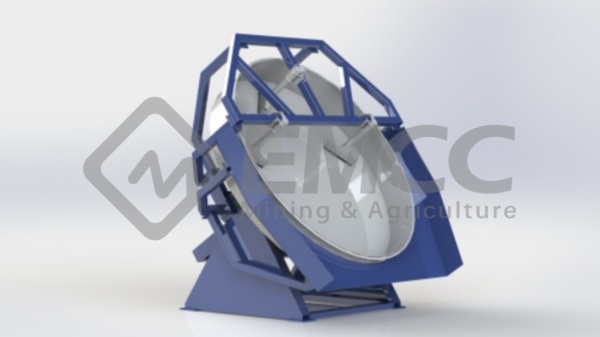
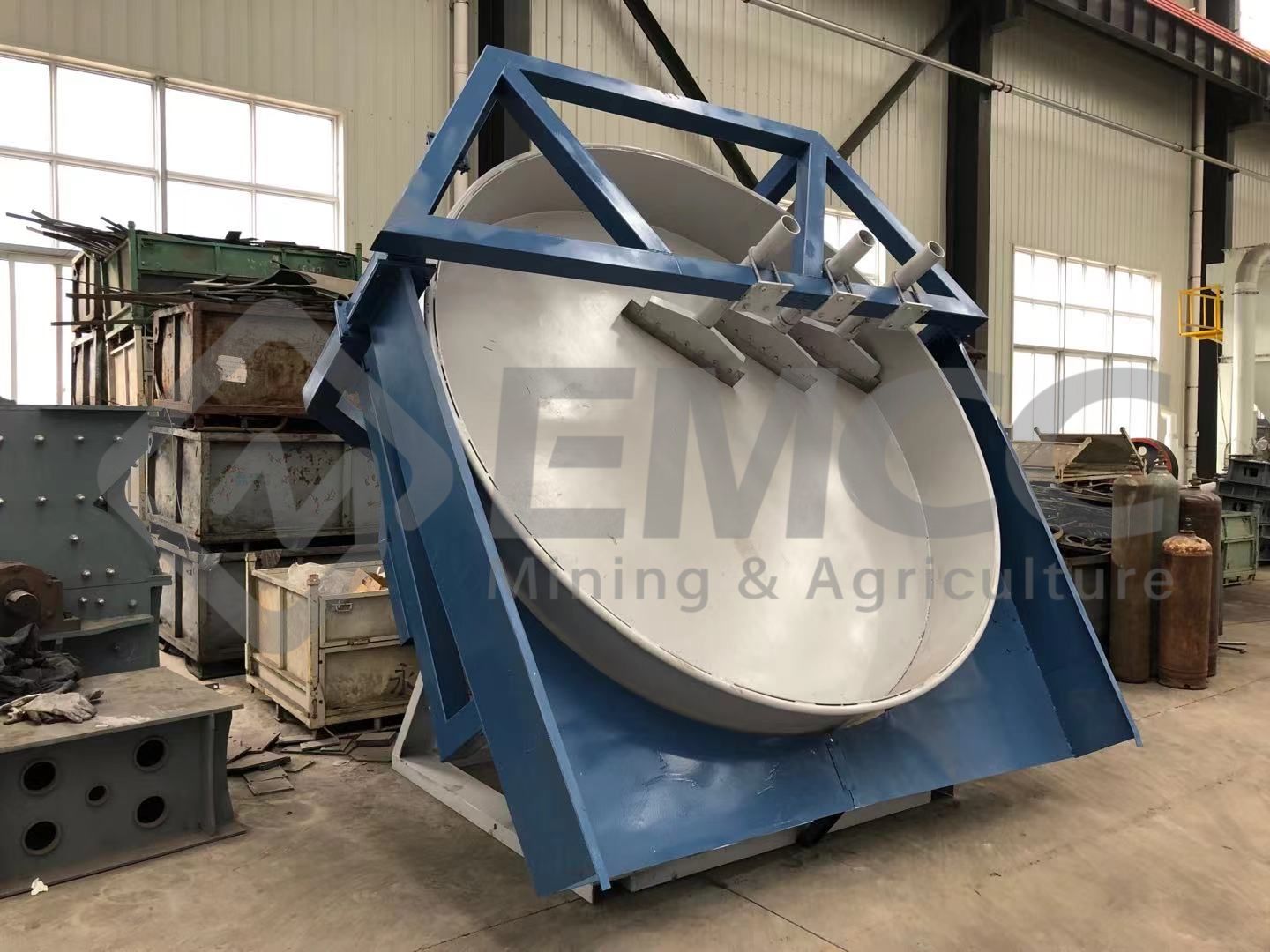
The EMCC Disc Granulator (pan pelletizer) is a robust wet granulation system that converts fine powders into uniform, spherical granules. Ideal for fertilizer disc granulation lines, it excels at producing high-strength NPK, humic acid organic, and chemical pellets. Manufactured by Shanghai Exceed Industry Co., Ltd.—a Shanghai-based leader in granulation technology—this machine delivers cost-effective, high-capacity, long-lifecycle performance with minimal downtime. Its modular design includes a precision-inclined disc, heavy-duty drive, rigid bracket, and integrated spraying system.
Applicable Materials & Fertilizer Types
EMCC Disc Granulators are High-Efficiency Wet Granulation suitable for:
▢ Inorganic Fertilizers granulation: NPK compound fertilizer, diammonium phosphate (DAP), monoammonium phosphate (MAP), superphosphate, potassium chloride, potassium sulfate, etc.
▢ Organic Fertilizers granulation: Humic acid, bio-organic fertilizer, livestock and poultry manure fermentation products, etc.
▢ Other Materials granulation: Mining powders (Limestone / Gypsum, Coal fines, Cement / Lime Kiln Dust, Pond tailings), chemical raw materials, etc.
Production Capacity Range
The Disc Granulator’s capacity covers everything from laboratory testing to industrial-scale mass production, with a single-unit processing capacity ranging from:
▢ Minimum: 0.2 tons/hour
▢ Maximum: 20 tons/hour
Customized designs are available to match fertilizer production lines of different scales based on customer requirements.
Disc Granulator Working Principle & Core Advantages
The EMCC Disc Granulator (pan pelletizer) uses wet agglomeration to convert fine powder into 1–6 mm spherical granules for NPK, humic acid, and chemical fertilizers.
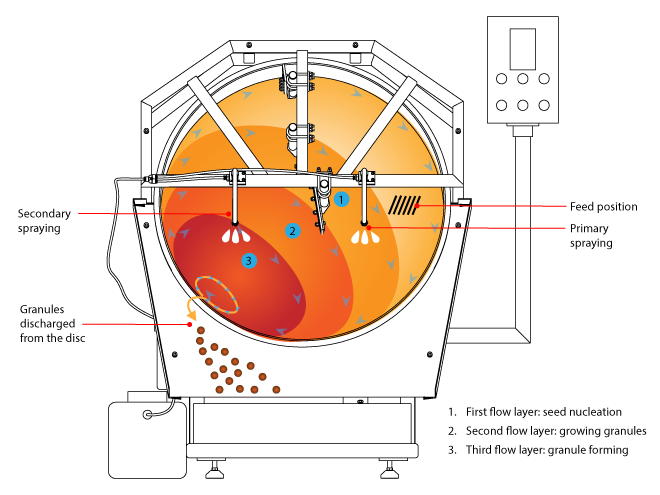
1. Seed Nucleation: Dry powder meets metered liquid binder on an inclined rotating disc → dense seed nuclei via capillary adhesion.
2. Layered Growth: Centrifugal + gravitational tumbling rolls seeds through dry feedstock → onion-skin layering boosts crush strength and nutrient uniformity.
3. Automatic Classification: Disc inclination (45°–55°) and frictional drag segregate by size; 1–6 mm pellets overflow, fines retain for extended residence time.
Diameter & Edge Height
Custom (TPH)
Bed depth, residence capacity
Inclination Angle
45°–55°
Cascading velocity, sphericity
10–30 rpm
Centrifugal hold vs. gravity flow
Clean disc, prevents buildup
Multi-point atomization
Moisture (15–30%)
✅︎ 80%–95% Efficiency | 10%–25% Recycle – Cost-effective wet granulation with high throughput.
✅︎ 1–6 mm Uniform Spherical Pellets – Built-in auto-classification ensures on-spec overflow.
✅︎ 45°–55° Stepless Incline | 10–30 rpm – Rapid tuning for NPK, organic, and humic acid formulations.
✅︎ Open-Pan Visual Operation – Intuitive monitoring and fast recipe changeover.
✅︎ 304/316L Stainless Steel Optional – Corrosion-resistant construction for organic & chemical applications.
EMCC Customization Disc Granulator Capabilities
▢ Speed 10–30 rpm | Incline 45°–55° – Tailored to flowability & bulk density for 1–6 mm pellets.
▢ Scraper Layout & Disc Height – Custom clearance (2–3 mm) for bed depth and residence time control.
▢ Material Options: Wear-resistant steel | 304/316L SS (anti-corrosion) | Non-stick polymer lining.
▢ Spray System: Multi-point atomization (hydraulic/air) for 15–30% homogenous moisture.
▢ Anti-Stick Coating Available – Ideal for high-organic, clay-rich formulations.
▢ PLC Interlocking – Seamless integration with batching, drying, and screening EMCC lines.
EMCC Disc Granulator Technical Specifications
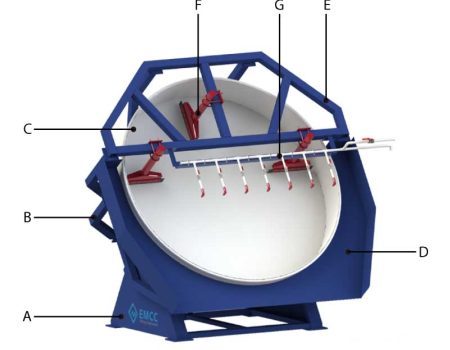
A – Install base
B – Support arm
C – Disc
D – Material receiving chute
E – Scraper holder
F – Scraper assembly
G – Spray assembly
Basic Technical Parameters Table
30
15
The above are the minimum and maximum basic parameters for EMCC Disc Granulators. For specific parameters, design drawings, or a quote tailored to your material, please 【Contact EMCC Engineer】 or 【Visit Official Website for Complete Cases】 .
● Supporting equipment: Crusher, Mixer, Elevator, Belt Conveyor
● Supporting environmentally friendly dust removal equipment: Pulse Dust Collector, Spray Tower
● Thermal equipment: Boiler, Combustion Device
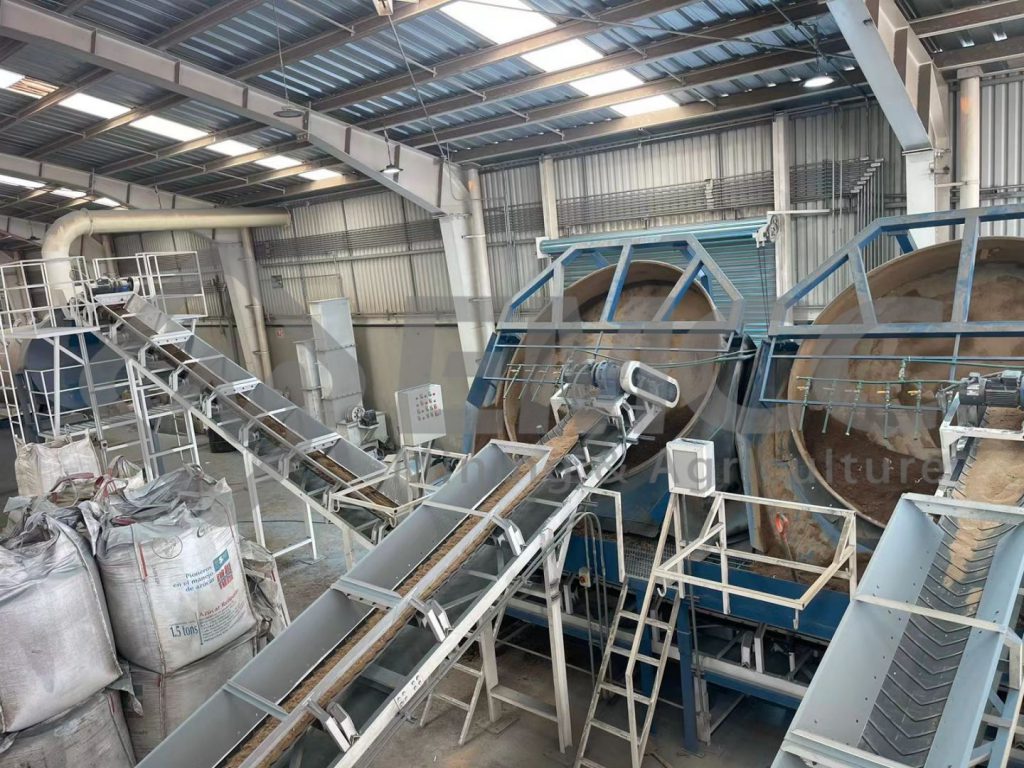
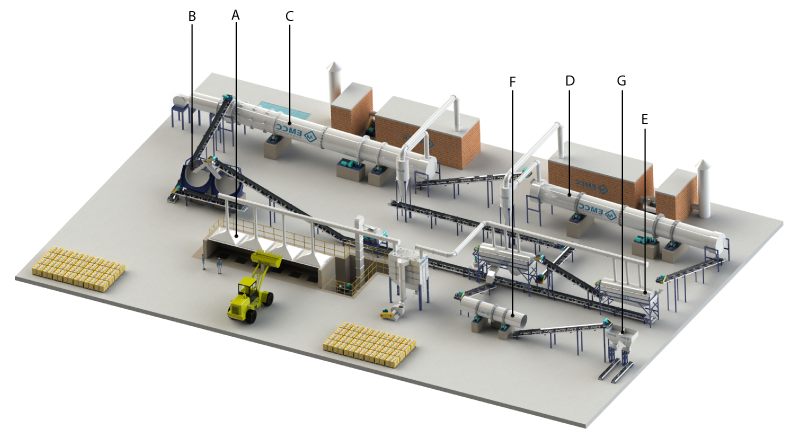
EMCC provides complete fertilizer production line solutions from batching, granulation, drying, cooling, screening, coating, to packaging, with custom designs based on customer capacity and process requirements.
Fertilizer raw material batching → Pretreatment and crushing → Mixing → Granulation → Drying → Cooling → Screening and recycling → Coating → Packaging → Finished product.
For specific parameters, design drawings, or a quote tailored to your material, please 【Contact EMCC Engineer】 or 【Visit Official Website for Complete Cases】 .
Technical Deep Dive
The following content details the advantages of Disc Granulators in fertilizer production and the process pathways. For specific parameters, design drawings, or a quote tailored to your material, please 【Visit Official Website for Testing Center】 or 【Contact Engineer to Schedule Material Testing】 .
Why choose a Disc Granulator for fertilizer?
The disc granulation line is a core wet granulation technology delivering high-roundness granules for NPK compound and pure organic fertilizers with quantifiable advantages:
● 80%–95% balling rate with 10%–25% return ratio (material and parameter dependent).
● Automatic classification via frictional segregation: 1–6 mm pellets overflow, fines remain for further growth.
● Open-pan visual operation enables real-time bed monitoring and rapid NPK/organic formulation changes.
● Integrated liquid dosing via multi-point spray for homogenous binder distribution or micronutrient addition.
How Does a Disc Granulator Produce High-Quality Fertilizer Granules?
Typical Process Pathways:
1. NPK Compound FertilizerN, P, K powders can be directly granulated into homogeneous compound fertilizer or separately granulated then dry-blended for custom NPK formulations.
2. DAP / MAP Production (Reaction Granulation)
During DAP/MAP production, the disc functions as both granulator and reactor: phosphoric acid slurry from a pre-neutralizer reacts with ammonia within the tumbling bed, with neutralization heat accelerating moisture evaporation and particle hardening.
3. Functional & Specialty Granules
Staged binder and mineral powder addition enables:
● Slow/Controlled-Release Fertilizers via polymer/sulfur coatings.
● Multi-Layer Granules with zoned nutrient release via onion-skin layering.
We not only provide reliable products, but more importantly, we provide reliable process design and experimentation.
Disc Granulator Design: From Standard to Custom
Achieving consistent high-capacity granulation requires precise process engineering beyond basic principles.
EMCC Design Focus:
● Feedstock type: Organic (fibrous, low density) vs. Inorganic (dense, abrasive).
● Target nutrient content and binder compatibility (water, steam, lignosulfonate, polymers).
Critical Design Parameters: Key parameters such as disc inclination, rotation speed, and scraper clearance are determined through material testing. For detailed parameter ranges, see the Working Principle section above.
The following content elaborates on how testing ensures the feasibility of the granulation process and equipment performance. For testing services tailored to your material, please 【Visit Official Website for Testing Center】 or 【Contact Engineer to Schedule Material Testing】 .
Why Material Testing is Critical for Disc Granulator Design
Raw material variability—in particle size, bulk density, moisture, and plasticity—makes empirical testing essential before commercial-scale disc granulator specification. A comprehensive program at the EMCC Innovation Center delivers the process design data required to mitigate scale-up risk.
✅ Testing Benefits for Wet Granulation
📌 Terminology: “Granulation” refers to wet granulation (also agitation agglomeration, tumble-growth, or non-pressure agglomeration).
How Testing Directly Informs Disc Granulator Engineering
A testing-driven design approach prevents:
▢ Failure to meet target granule size (1–6 mm). ▢ Chronic process upsets and production losses
▢ Excessive binder use or high recycle burden
A testing-driven design approach prevents:
▢ Failure to meet target granule size (1–6 mm).
▢ Chronic process upsets and production losses
▢ Excessive binder use or high recycle burden
1️⃣ Characterizing Material Agglomeration Behavior
Chemical Composition
2️⃣ Key Process Parameters from Controlled Trials
3️⃣ De-Risking Scale-Up: Pilot Testing Before Fabrication Bench-scale success does not guarantee continuous pilot performance. Common scale-up anomalies include:
● Bridging / ratholing in full-scale feed hoppers
● Unstable cascading due to larger disc linear speeds
● Fibrous material wrapping around scrapers or nozzles
● Bimodal granule distribution from inconsistent sheet formation
Pilot-scale testing at the EMCC Innovation Center identifies these issues before equipment fabrication—enabling low-cost design adjustments. Operators also gain hands-on familiarity, accelerating future troubleshooting of raw material variations.
Disc Granulator Frequently Asked Questions (FAQ)
The following FAQ covers equipment selection, process design, and capacity matching. For a specific solution tailored to your material, please [Visit the EMCC Main Site to View the Complete Product Line] or [Contact an Engineer for a Free Assessment].
Answer: Raw material data: composition, moisture content, bulk density, temperature. Product data: target particle size (1–6 mm), pellet density, crush strength. Process data: construction materials, electrical controls, ambient temperature/humidity. Most obtained via material testing. EMCC provides complete process data collection.
Answer: Depends on capacity (0.2–20 tph), granule quality, and process conditions. Pilot-scale material testing is the most reliable validation method.
Suitable: Small batches with frequent formula changes, high sphericity requirements, high-moisture organic waste (fermented manure), liquid micronutrient addition.
Less suitable: Sealed reaction granulation (e.g., DAP ammoniation), >30 t/h single-line capacity (consider rotary drum), zero-tolerance dust emissions, non-hydrophilic materials.
[Schedule Material Testing] or [Submit Process Parameters]
Answer: Retention time (30 sec – 20 min) directly impacts pellet quality.
● Longer time → more revolutions → higher density & crush strength, lower throughput.
● Shorter time → loose pellets, <8 N/pellet, prone to breakage.
To increase strength, extend retention time by flattening inclination 1°–2° or reducing speed.
Answer: EMCC recommendations:
● Pre-dry incoming material to standardize moisture.
● Back mix dry product with fresh feed to dilute variability.
● Optimize upstream mixing for binder-powder contact.
● Implement inspection: test moisture, fineness (80% passing 80-mesh), bulk density per batch; adjust spray rate and inclination.
Answer: Disc granulation relies on liquid bridges between fine powders.
● Too coarse (>20% oversize) → binder contact insufficient → granulation rate drops 20–25%.
● Too fine (>30% dust) → over-saturation → paste formation, disc sticking.
Optimal particle size ensures stable classifying motion and onion-skin layering.
Answer: Feed/discharge systems, screening & recycle system (returns off-spec fines), downstream rotary dryer (removes 15–30% moisture), optional upstream mixer.
Answer:
● Automated (PLC + MCC + HMI): online moisture monitoring, coordinated feed/spray control, start/stop sequencing, safety interlocks.
● Operator-dependent: spray pattern uniformity (visual), cascading bed trajectory (visual), pellet sphericity and finish assessment.
[Visit EMCC Official Website for Control System]
Answer:
1. Material testing → determine % fill (10–20%), retention time, speed (10–30 rpm), inclination (45–55°), spray design.
2. Data-driven sizing → disc diameter, edge height, drive power for target TPH.
3. Complete line integration → batching, drying, screening equipment.
Answer: Yes. Wet agglomeration adds liquid binder, leaving 15–30% moisture. A rotary dryer removes moisture while rounding and polishing granules.
EMCC offers complete lines: granulation → drying → cooling → screening → coating → packaging.
Answer: Scrapers (2–3 mm clearance), spray nozzles (erosion/clogging), pinion gear. Improper inclination/speed accelerates wear.
Answer: Typically continuous. Batch operation possible at EMCC Innovation Center for R&D.
Answer: Causes: excessive moisture, improper temperature, off-spec parameters.
Solutions: self-cleaning scrapers, reduce spray volume / increase recycle, adjust speed (10–30 rpm) and inclination (45–55°), enhance cooling, apply anti-caking agents if needed.
Answer: Root cause: spray nozzle misalignment. Spray must hit cascading material bed, not bare disc.
Solutions: reposition nozzles to material cascade, verify moisture (organic >35% highly prone to sticking), maintain scraper-to-disc gap at 2–3 mm.
Answer:
Disc Granulator: Capacity 0.2–20 tph. Superior sphericity (auto-classification). Excellent formulation flexibility (open pan). Moderate dust. Lower investment.
Rotary Drum Granulator: Capacity 1–100+ tph. Good sphericity. Moderate flexibility (closed system). Low dust (sealed). Higher investment.
[View Full Comparison] or [Contact Engineer]
Answer:
● Follow Lockout/Tagout/Tryout (LOTO).
● Monitor unusual noise, vibration, odor daily.
● Maintenance only per EMCC guidelines.
● Document all work: date, parts, condition, personnel.
● Shut down completely before inspection, lubrication, or adjustment.
[Full Maintenance Article]
Why Choose EMCC
10+ Years Industry Experience
Dedicated to providing granulation, drying, cooling, and conveying solutions of various raw materials.
100+ Global Sucess Cases
Standardized service procedures and comprehensive after-sales ensure smooth project execution.
50+ Persons Design & Service Team
Access to consultation, design, machines, installation, training, on-site guidance, spare parts, and daily maintenance.
Dedicated to providing granulation, drying, cooling, and conveying solutions of various raw materials.
Integrated Steel Plate Fabrication
Max. drum-type equipment processing: Ø4.5 m, Robust structure and high-quality components extended service life.
Standard Service Process
Consultation > Trial Analysis > Solution Design > Quotation & Contracting > Equipment Fabrication > Assisted Installation & Commissioning > Ongoing After-sales Support